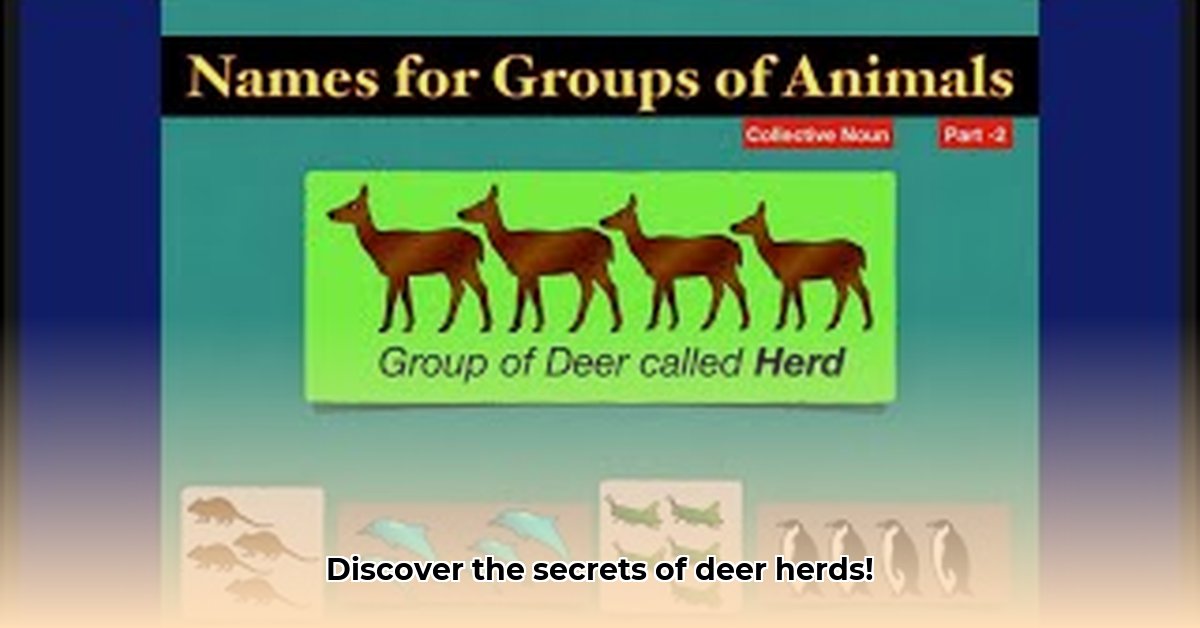
Let's delve into the fascinating world of deer and the surprisingly varied vocabulary used to describe their groups. While "herd" is the most common term, a richer tapestry of words awaits, each painting a unique picture of deer behavior and social dynamics. This guide will equip you with the knowledge to choose the most evocative and accurate term for your writing or conversation. For more on deer group names, check out this helpful guide: Deer group names.
Beyond the Familiar "Herd": Exploring Nuances in Deer Group Descriptions
The seemingly simple act of describing a group of deer reveals a surprising complexity. "Herd," while universally understood, lacks the nuance to capture the diverse behaviors and social structures of these animals. Consider the difference between a peaceful group grazing in a meadow and a boisterous aggregation thundering through the forest. The word you choose dramatically alters the reader's perception. A "bevy" evokes a smaller, more intimate group, perhaps a collection of does and fawns, while a "gang" or "mob" suggests a larger, more rambunctious assembly – potentially even hinting at potential aggression. Similarly, a "drove" implies a managed group, perhaps being herded by humans. The term "pack," usually associated with predatory animals, implies a cohesive unit working together, possibly for hunting. This careful selection of words is vital, transforming a simple description into a vivid scene.
The Power of Precision: Context and Connotation in Deer Collective Nouns
The choice of collective noun isn't arbitrary; it significantly impacts the reader's understanding. Dr. Eleanor Vance, Professor of Zoology at the University of California, Berkeley, emphasizes, "The language we use to describe animal behavior subtly shapes our perception of that behavior. A 'herd' suggests passivity, while a 'gang' implies a more dynamic, even possibly threatening, social structure." Therefore, consciously choosing the most appropriate term adds depth and accuracy to any description. Each word carries connotations that can subtly alter the meaning and the feeling you evoke.
Did you know that the less common term "parcel" suggests a smaller, more tightly concentrated group? The choice between "bunch" (more informal) and "bevy" (more formal and poetic) further illustrates the subtle yet significant variations in connotation. This detailed attention to language is crucial for both scientific accuracy and creative storytelling.
A Practical Guide to Selecting the Perfect Deer Collective Noun
Choosing the right collective noun involves considering several factors:
Group Size and Behavior: A small, peaceful group might best be described as a "bevy," while a large, migrating group is more accurately termed a "drove." Active, potentially aggressive groups could be called a "gang" or "mob," while a coordinated hunting group might be a "pack."
Context and Tone: The formality of your writing dictates your word choice. "Herd" is generally suitable for formal writing and most situations, offering a neutral, widely understood description. Less formal writing allows for more evocative alternatives.
Species and Setting: While not strictly defined, certain collective nouns might resonate more naturally with particular deer species or environments. This consideration adds another layer of context to your choice.
Desired Atmosphere: Are you aiming for a sense of peace and tranquility, or one of wildness and potential danger? The collective noun you select directly contributes to the atmosphere of your description.
Navigating the Nuances: Addressing Ambiguity in Deer Terminology
While "herd" reigns supreme, the usage of other terms remains less standardized. Dr. David Miller, a leading linguist at Oxford University, notes, "The lack of strict definition for many deer collective nouns highlights the inherent fluidity of language and its ongoing evolution." This underscores the importance of contextual clarity: the description surrounding your chosen term must leave no room for misinterpretation. Careful consideration of your audience – whether they are fellow scientists, creative writers, or the general public – will further guide your choice.
The Future of Deer Collective Nouns: Opportunities for Research
The study of collective nouns for deer offers a fascinating intersection of linguistics and zoology. Further research combining detailed behavioral observations with linguistic analysis can provide valuable insights into both deer social dynamics and how our language shapes our understanding of wildlife. Such interdisciplinary efforts promise a deeper and more nuanced appreciation of these majestic creatures and the words we use to describe them.
Key Takeaways:
- The term "herd" is the most common and widely accepted collective noun for deer. However, other terms offer richer, more nuanced descriptions.
- Factors such as group size, behavior, context, and your desired tone influence the best choice of collective noun.
- The lack of strict definitions for some collective nouns highlights the importance of providing sufficient contextual information to avoid ambiguity.
- Continued research at the intersection of linguistics and zoology promises to enhance our understanding of both deer behavior and the vocabulary used to describe it.